
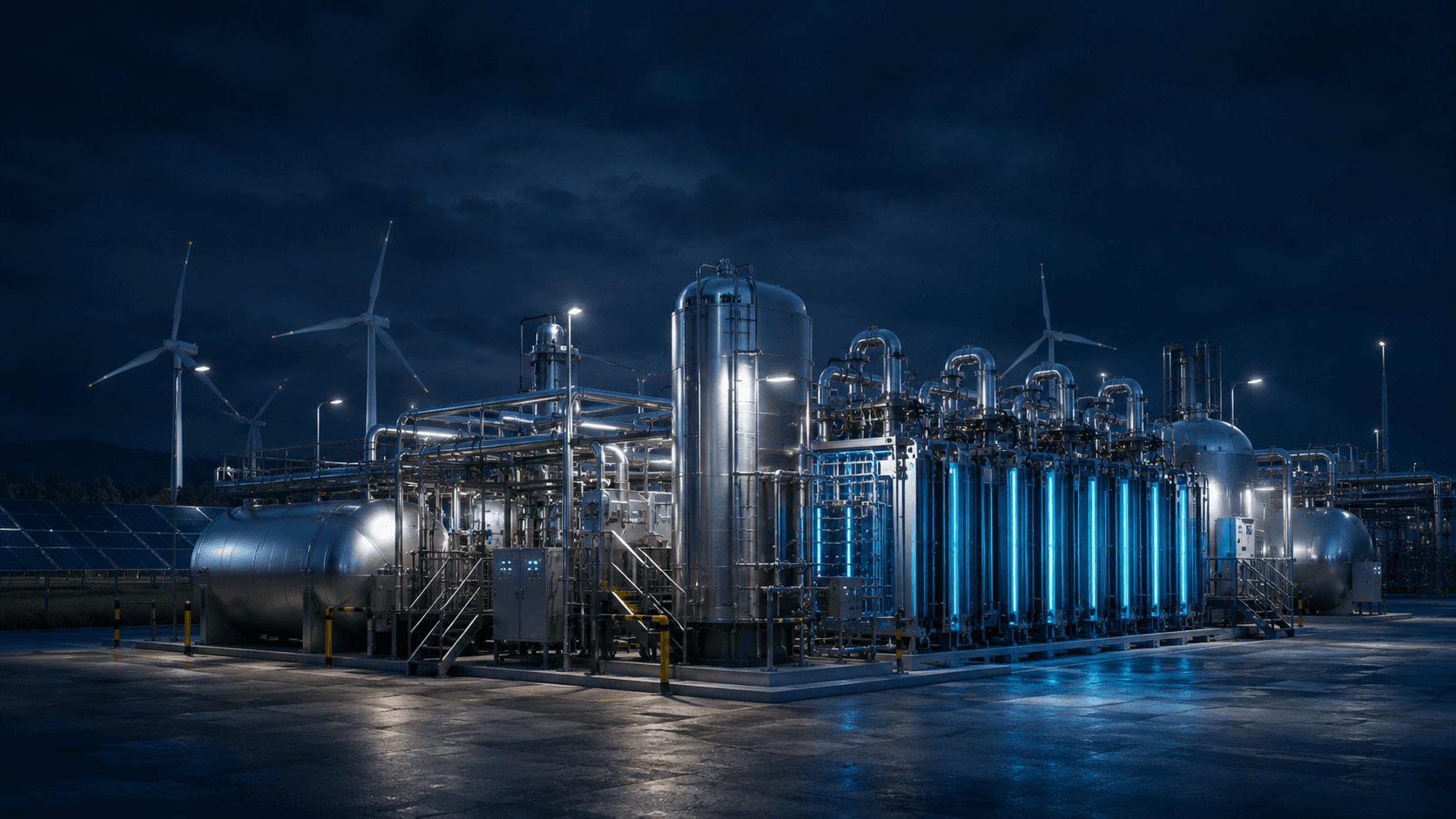
Green hydrogen has become one of the most discussed technologies in the global energy transition. Governments, utilities and industrial companies have announced hundreds of projects aimed at producing hydrogen using renewable electricity rather than fossil fuels.
Most discussions focus on renewable power generation, hydrogen storage and future demand. What receives far less attention is the chemical supply chain that makes hydrogen production possible.
Every electrolyzer contains specialized catalysts, membranes, coatings, water treatment chemicals and engineered materials. As green hydrogen projects move from demonstration facilities to commercial deployment, demand for these specialty materials is becoming a meaningful new growth category for the chemical industry.
Why Electrolyzers Are Really Chemical Systems
An electrolyzer uses electricity to split water into hydrogen and oxygen.
While the process appears straightforward, commercial systems depend on highly engineered chemical materials that determine:
Efficiency.
Durability.
Operating costs.
Hydrogen purity.
Equipment lifespan.
The choice of electrolyzer technology directly influences which chemical inputs are required.
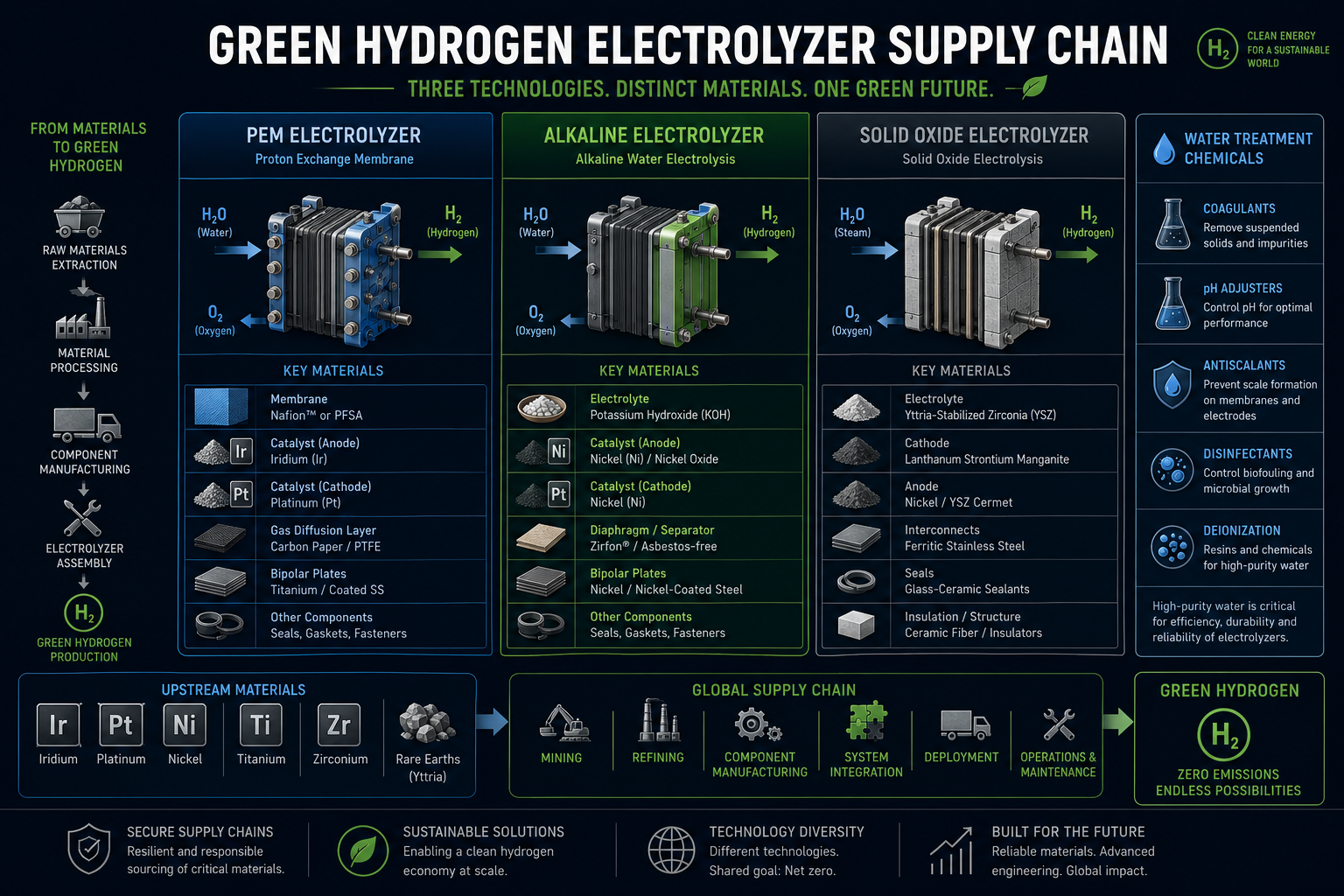
Today, three major electrolyzer technologies dominate market discussions:
PEM (Proton Exchange Membrane).
Alkaline Electrolyzers.
Solid Oxide Electrolyzers.
Each technology creates a different demand profile for specialty chemical suppliers.
PEM Electrolyzers Depend on High-Value Specialty Materials
PEM technology is widely viewed as one of the most advanced hydrogen production systems available today.
Its key advantage is the ability to respond quickly to fluctuating renewable electricity inputs.
However, PEM systems depend on expensive specialty materials.
Critical inputs include:
Proton exchange membranes.
Iridium catalysts.
Platinum catalysts.
Fluoropolymer materials.
Specialty coatings.
The membrane itself is one of the most important components because it allows proton transport while preventing gas crossover.
This creates significant opportunities for specialty chemical and advanced materials companies.
Iridium Is Emerging as a Major Bottleneck
Among all PEM inputs, iridium receives the most attention.
Iridium is used in oxygen evolution catalysts and is one of the rarest industrial metals in commercial use.
Challenges include:
Limited global production.
Geographic concentration.
High costs.
Long development timelines for new supply.
Many analysts consider iridium availability one of the most significant constraints facing large-scale PEM electrolyzer deployment.
As hydrogen projects multiply, catalyst efficiency improvements are becoming a critical area of innovation.
Alkaline Electrolyzers Use More Established Chemistry
Alkaline electrolyzers represent the most mature hydrogen production technology.
Unlike PEM systems, they generally avoid reliance on precious metals.
Important chemical inputs include:
Potassium hydroxide (KOH).
Nickel catalysts.
Electrolyte additives.
Corrosion-resistant coatings.
Because alkaline systems rely on more widely available materials, they often benefit from lower capital costs.
This explains why many large-scale industrial hydrogen projects continue to favor alkaline technology despite the growing popularity of PEM systems.
Solid Oxide Systems Introduce Advanced Ceramic Demand
Solid oxide electrolyzers operate at significantly higher temperatures than other technologies.
This creates different material requirements focused on advanced ceramics and high-temperature stability.
Key inputs include:
Ceramic electrolytes.
Rare earth materials.
Specialty oxides.
High-temperature catalysts.
Advanced thermal management materials.
Although commercial deployment remains smaller than PEM and alkaline systems, solid oxide technology offers attractive efficiency potential for industrial applications with access to waste heat.
Water Treatment Chemicals Are Often Overlooked
Hydrogen projects require exceptionally pure water.
Impurities can damage membranes, reduce efficiency and shorten equipment life.
As a result, hydrogen facilities consume significant quantities of:
Ion exchange resins.
Water treatment chemicals.
Antiscalants.
Specialty filtration media.
Purification additives.
For chemical suppliers, water treatment may ultimately become one of the most stable and recurring demand categories within the hydrogen value chain.
Balance-of-Plant Chemicals Create Additional Demand
Beyond the electrolyzer itself, hydrogen facilities require numerous supporting chemical products.
These include:
Cooling fluids.
Corrosion inhibitors.
Lubricants.
Specialty coatings.
Cleaning chemicals.
While less visible than catalysts or membranes, these materials represent an important part of total lifecycle operating costs.
As installed hydrogen capacity expands, recurring maintenance demand will become increasingly significant.
Which Materials Face the Greatest Supply Risk?
Not all electrolyzer materials face equal supply challenges.
Current areas of concern include:
High Risk
Iridium.
Platinum-group metals.
Certain fluoropolymer membranes.
Advanced ceramic materials.
Moderate Risk
Nickel catalysts.
Rare earth oxides.
Specialty ion exchange materials.
Lower Risk
Potassium hydroxide.
Standard water treatment chemicals.
Industrial coatings.
Understanding these constraints is becoming increasingly important for project developers and procurement teams.
How Hydrogen Project Pipelines Translate Into Chemical Demand
The green hydrogen industry is moving from pilot projects toward commercial deployment.
This shift changes demand dynamics.
Early-stage projects primarily consumed:
Engineering services.
Research materials.
Demonstration equipment.
Commercial-scale deployment creates demand for:
Large-volume catalyst materials.
Membrane manufacturing.
Water treatment systems.
Operational chemicals.
Replacement components.
As project pipelines mature, chemical demand becomes more predictable and scalable.
What Chemical Suppliers Should Watch Through 2030
The most important indicators include:
Final investment decisions on hydrogen projects.
Electrolyzer manufacturing expansion.
Catalyst technology developments.
Membrane production capacity.
Critical mineral supply trends.
Government hydrogen incentives.
The suppliers best positioned for growth will likely be those serving multiple electrolyzer technologies rather than relying on a single platform.
The Bottom Line
Green hydrogen is often described as an energy transition opportunity, but it is equally a specialty chemicals opportunity. Every electrolyzer relies on membranes, catalysts, electrolytes, coatings and purification systems that transform renewable electricity into hydrogen.
PEM systems are driving demand for high-value membrane and catalyst materials. Alkaline electrolyzers continue creating demand for potassium hydroxide and nickel-based chemistries. Solid oxide technologies are opening opportunities in advanced ceramics and specialty oxides.
As hydrogen projects move from announcements to construction, the chemical supply chain supporting electrolyzer deployment is becoming a meaningful growth market in its own right. For specialty chemical producers, the hydrogen economy may prove to be as important a materials story as it is an energy story.
Interested in hydrogen-related specialty chemicals, catalysts or advanced materials? Explore verified suppliers and emerging market opportunities on our platform today.
Potassium Hydroxide (95%) - China CAS: 1310-58-3