
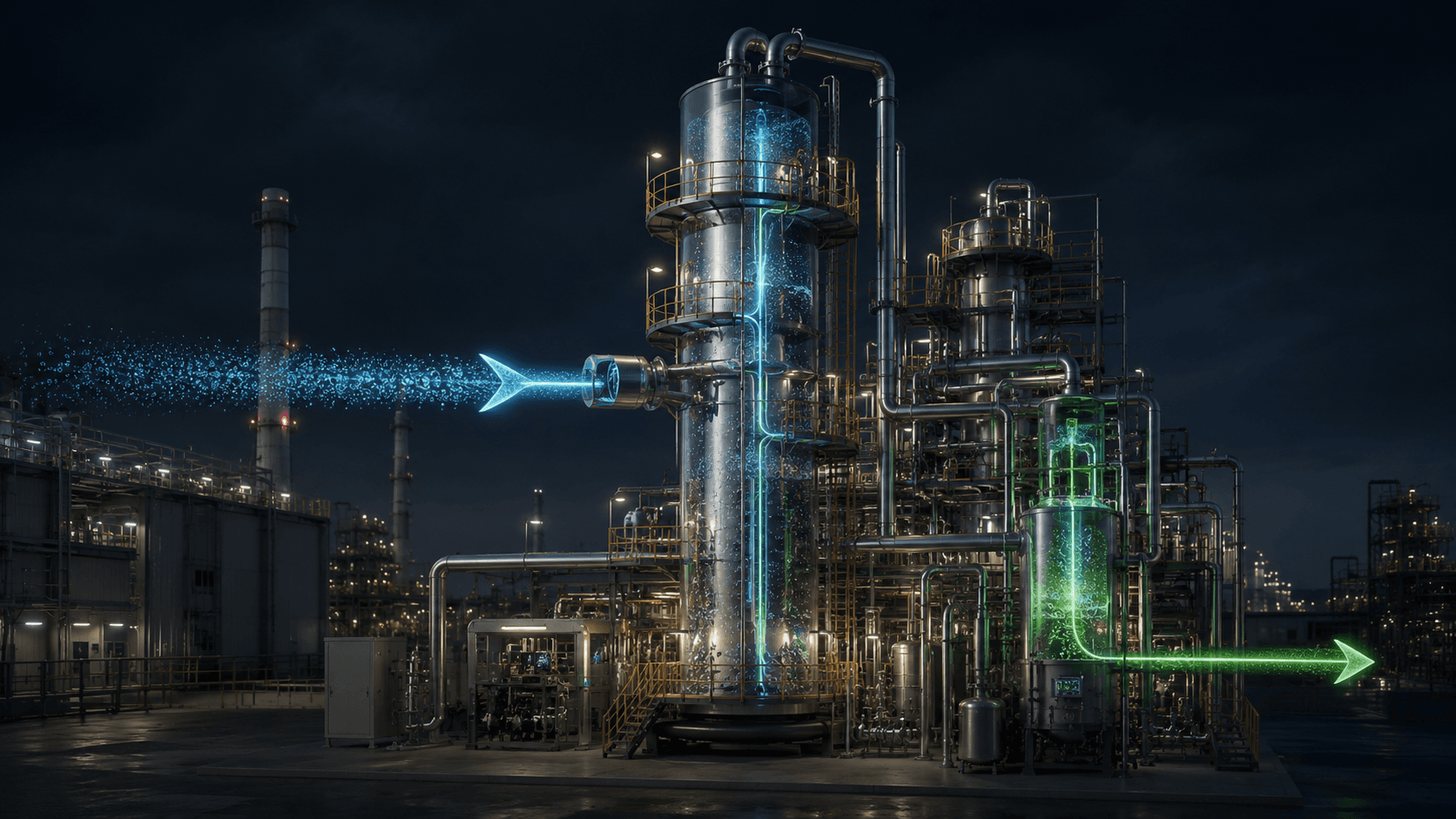
When most people think about carbon capture, they picture pipelines, storage reservoirs and industrial smokestacks. Yet the true engine behind carbon capture technology is chemistry.
Every major carbon capture system depends on specialized materials capable of selectively removing carbon dioxide from industrial exhaust streams. Whether the technology relies on liquid solvents, solid sorbents or advanced membrane systems, chemical inputs determine capture efficiency, operating costs and project economics.
As governments and industries invest billions into decarbonization initiatives, a new specialty chemicals market is emerging. The companies supplying these materials may become some of the most important beneficiaries of the global carbon capture buildout.
Why Carbon Capture Is Creating a New Chemical Market
Carbon capture technologies are moving beyond research programs and demonstration plants.
Growth is being supported by:
Net-zero commitments.
Industrial decarbonization targets.
Carbon pricing mechanisms.
Government incentives.
Energy transition investment programs.
As projects advance toward commercial operation, demand for specialized capture materials is increasing.
Unlike traditional commodity chemicals, carbon capture materials compete on:
Capture efficiency.
Regeneration costs.
Energy consumption.
Operating stability.
Lifetime performance.
This creates opportunities for higher-value specialty chemical products rather than purely volume-driven markets.
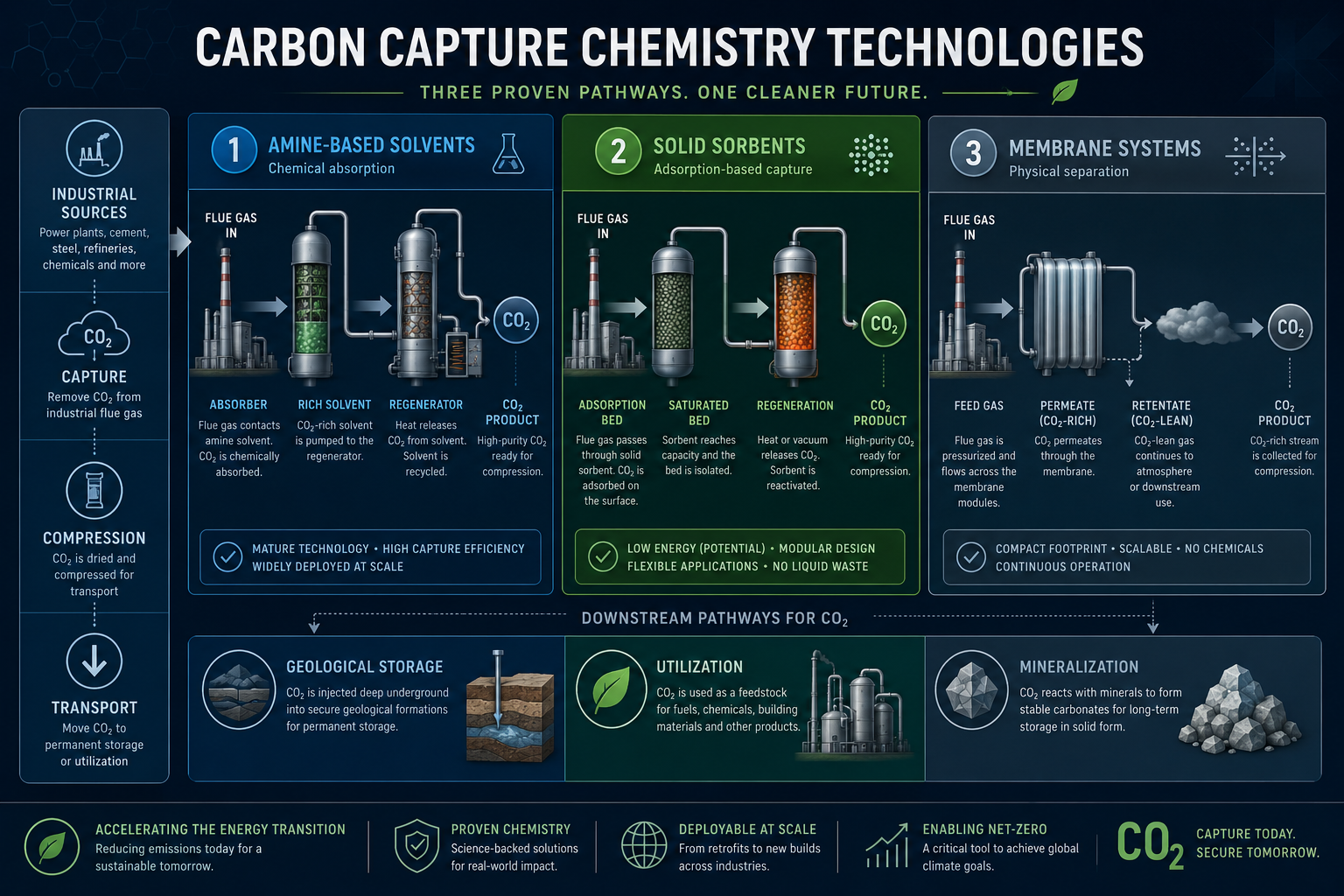
Amine-Based Solvents Remain the Industry Standard
The largest commercial segment today remains liquid solvent systems.
Most existing carbon capture projects rely on amine-based solvents that chemically bind with carbon dioxide before releasing it during regeneration.
Common solvent families include:
Monoethanolamine (MEA).
Diethanolamine (DEA).
Methyldiethanolamine (MDEA).
Advanced proprietary amine blends.
These systems dominate because they offer:
Proven commercial performance.
Established operating experience.
Scalable deployment.
High capture efficiency.
As new projects come online, amine demand is expected to remain the foundation of the carbon capture chemicals market.
Solid Sorbents Are Gaining Momentum
While liquid solvents dominate current installations, solid sorbent technologies are attracting growing interest.
These materials capture CO₂ through adsorption rather than chemical absorption.
Examples include:
Activated carbon systems.
Zeolites.
Metal-organic frameworks (MOFs).
Functionalized polymer sorbents.
Advantages can include:
Lower energy requirements.
Reduced corrosion.
Smaller equipment footprints.
Simplified solvent management.
Although many applications remain in early commercialization stages, sorbent technologies are increasingly viewed as promising solutions for next-generation carbon capture systems.
Membrane Technology Offers a Different Approach
Membrane-based systems separate carbon dioxide through selective permeability rather than chemical reaction.
These technologies utilize advanced materials designed to allow CO₂ to pass while blocking other gases.
Applications include:
Natural gas processing.
Hydrogen production.
Industrial gas separation.
Carbon capture systems.
The appeal of membranes includes:
Lower operational complexity.
Reduced chemical handling.
Modular system design.
Potentially lower maintenance requirements.
However, performance and economics remain highly application-dependent.
Which Companies Are Positioning for Growth?
A broad range of chemical and engineering companies are investing in carbon capture materials.
Market participants include:
Specialty amine producers.
Activated carbon manufacturers.
Advanced materials developers.
Membrane technology suppliers.
Industrial gas companies.
Many suppliers are leveraging existing expertise in:
Water treatment.
Gas processing.
Specialty polymers.
Catalysis.
Adsorbent materials.
This allows them to enter carbon capture markets without building entirely new business models.
Why the Market Is Different From Traditional Chemicals
Carbon capture materials differ from conventional chemical products in several important ways.
Purchasing decisions often depend on:
Lifetime performance.
Regeneration efficiency.
Carbon removal cost.
System integration.
Energy consumption.
As a result, suppliers frequently sell complete technical solutions rather than simple chemical products.
This creates stronger customer relationships and potentially higher margins than traditional commodity markets.
The Demand Opportunity Is Real—but Gradual
One of the biggest misconceptions surrounding carbon capture is the expectation of immediate explosive demand.
The reality is more measured.
Commercial-scale carbon capture projects require:
Significant capital investment.
Regulatory approvals.
Infrastructure development.
Long project timelines.
As a result, chemical demand growth will likely follow a staged pattern rather than a sudden surge.
Near-term growth is expected to come from:
Industrial decarbonization projects.
Refinery applications.
Natural gas processing.
Cement production.
Steel manufacturing.
These sectors offer some of the largest opportunities for large-scale CO₂ capture deployment.
Challenges Still Facing the Industry
Despite growing momentum, several challenges remain.
Key issues include:
High project costs.
Energy-intensive regeneration requirements.
Infrastructure limitations.
Carbon transport constraints.
Long investment cycles.
For chemical suppliers, success will depend on improving performance while reducing operating costs.
The most valuable products will be those that help customers capture more carbon using less energy.
What Procurement Teams Should Watch Through 2030
Companies involved in carbon capture should monitor:
Commercial project approvals.
Carbon pricing developments.
Amine solvent demand growth.
Sorbent technology commercialization.
Membrane performance improvements.
Government incentive programs.
The market is likely to evolve rapidly as technology matures and deployment scales.
The Bottom Line
Carbon capture is creating one of the most interesting new specialty chemical markets of the energy transition era. While infrastructure projects attract most of the headlines, the chemistry behind those projects will ultimately determine their performance and economics.
Amine-based solvents remain the dominant technology today, but solid sorbents and advanced membrane systems are gaining traction as developers seek lower-cost and more efficient solutions. As carbon capture projects move from pilot programs to commercial deployment, demand for specialized chemical materials is expected to grow steadily.
For specialty chemical producers, the opportunity is not simply selling chemicals—it is becoming part of the technological foundation that enables industrial decarbonization worldwide.
Interested in carbon capture chemicals, specialty solvents or advanced materials? Explore verified suppliers and emerging market opportunities on our platform today.
Monoethylene glycol CAS: 107-21-1