
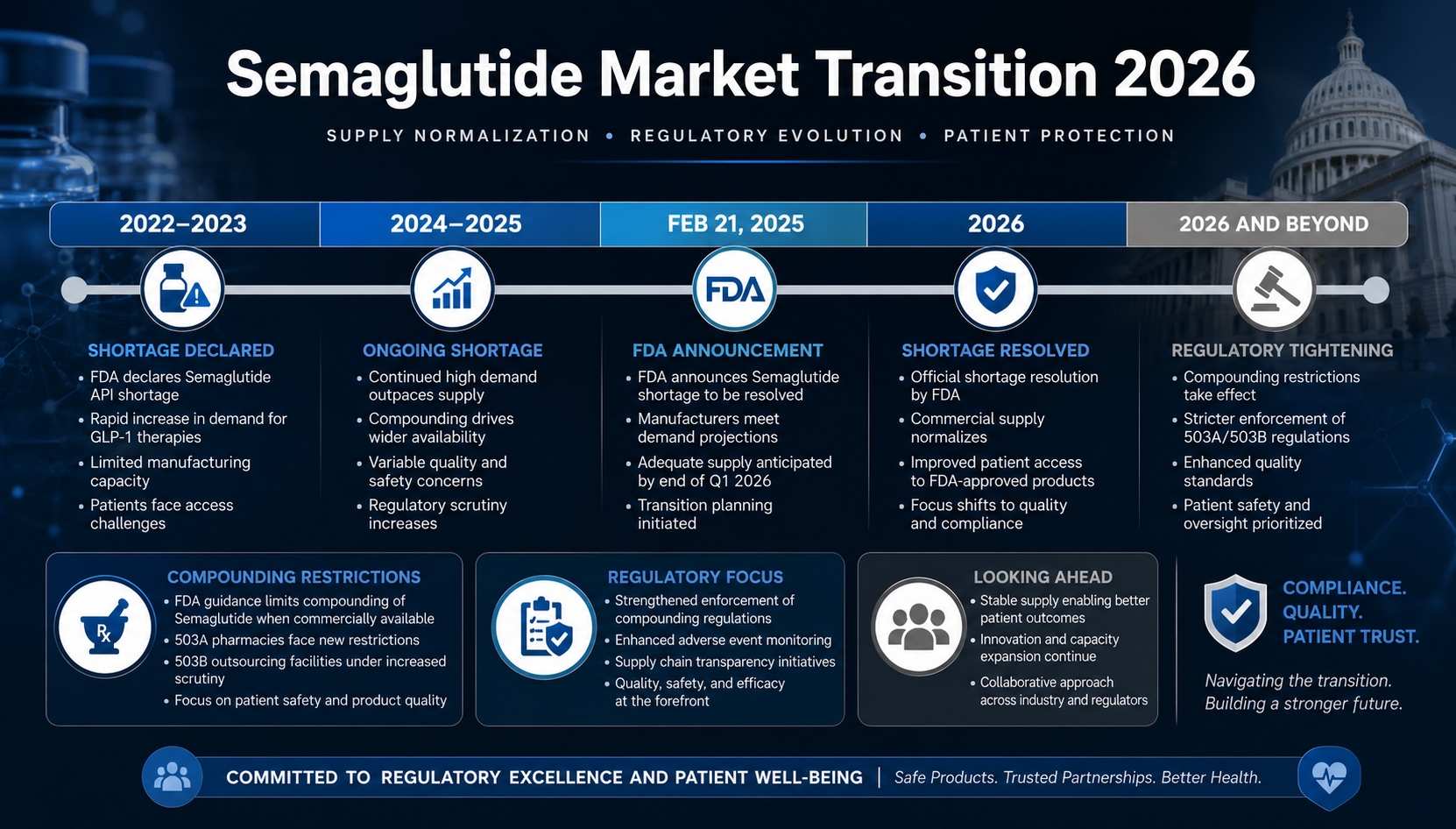
The semaglutide shortage defined much of the pharmaceutical industry's discussion around obesity and diabetes therapies for nearly four years.
As demand surged far beyond original forecasts, manufacturers struggled to keep pace, creating shortages that affected patients, healthcare providers, pharmacies and pharmaceutical supply chains worldwide.
In February 2026, however, a major turning point arrived.
The FDA officially confirmed that the semaglutide injection shortage had been resolved, ending a supply disruption that began in 2022.
While this announcement is positive for patients and healthcare systems, it also marks the beginning of a new regulatory phase—one that places greater emphasis on compliance, quality assurance and legitimate pharmaceutical sourcing.
Why the Semaglutide Shortage Lasted So Long
The shortage was not caused by a lack of demand alone.
Several supply chain constraints occurred simultaneously:
Limited peptide synthesis capacity.
API manufacturing bottlenecks.
Fill-finish constraints.
Device assembly limitations.
Cold-chain logistics requirements.
Demand growth dramatically exceeded available production capacity.
As a result, manufacturers spent years expanding facilities, increasing production and strengthening supply chains to restore market balance.
The FDA's decision indicates that those efforts have now achieved sufficient success to meet current market demand.
What Changes When a Shortage Is Declared Resolved?
Drug shortage status has important regulatory implications.
During shortages, certain exceptions may allow alternative supply pathways to support patient access.
Once the shortage ends, those exceptions typically become more limited.
This is exactly what is now occurring within the semaglutide market.
The FDA's updated guidance significantly tightens the circumstances under which compounded semaglutide products may be produced.
For compounding pharmacies, this represents a major shift.
For pharmaceutical manufacturers, it restores a more traditional regulatory framework.
The Impact on 503A Compounders
Many compounding pharmacies expanded GLP-1 offerings during the shortage period.
The shortage environment created opportunities for:
Patient access solutions.
Alternative formulations.
Compounded equivalents.
With the shortage officially resolved, regulatory flexibility is narrowing.
As a result:
Production pathways become more restricted.
Compliance requirements become more important.
Market participation becomes more limited.
The policy shift is expected to reduce the availability of compounded semaglutide alternatives over time.
What Procurement Teams Should Do Now
Pharmaceutical sourcing teams should use this transition period to reassess supplier strategies.
Key priorities include:
Review Supplier Qualification Programs
Verify that suppliers maintain appropriate regulatory compliance.
Strengthen Audit Procedures
Conduct more rigorous supplier assessments where appropriate.
Evaluate Supply Chain Traceability
Ensure complete visibility from API production through finished product manufacturing.
Monitor Regulatory Developments
GLP-1 regulatory oversight continues evolving rapidly.
Diversify Qualified Sources
Avoid overreliance on a single supplier or manufacturing site.
Organizations that proactively strengthen procurement controls will be better positioned as regulatory expectations continue increasing.
Implications for the Broader GLP-1 Market
The semaglutide shortage resolution may also influence:
Tirzepatide markets.
Peptide manufacturing demand.
CDMO utilization.
API investment decisions.
As one of the largest pharmaceutical supply chain disruptions begins to ease, manufacturers may redirect resources toward future growth opportunities.
However, demand for GLP-1 therapies remains exceptionally strong, meaning capacity planning will continue to be a strategic priority across the industry.
The Bottom Line
The FDA's confirmation that the semaglutide shortage has been resolved marks the end of a significant chapter in pharmaceutical supply chain history. Yet the announcement is not simply about improved availability—it also signals a shift toward stricter regulatory oversight, tighter compounding rules and greater scrutiny of API sourcing practices.
For pharmaceutical procurement teams, the lesson is clear: quality, compliance and traceability are becoming even more important as the market transitions from shortage management to long-term supply stability.
Companies that invest in qualified suppliers, robust compliance systems and transparent sourcing practices will be best positioned to succeed in the next phase of the rapidly evolving GLP-1 market.
Distilled Monoglyceride (E471) CAS: 123-94-4